For most of the last three decades, a low monthly HOA fee at Barefoot Beach Club read as good news. It signaled a well-run building, modest overhead, more of the purchase price going toward the view instead of the ledger. In 2026, that same low number often means the opposite. It can be the first sign that a board spent years underfunding the account that pays for roofs, load-bearing walls, and waterproofing, and that the bill is about to land on whoever owns the unit when it comes due.
That reversal is not a shift in buyer mood. It is the direct result of a Florida law that finished phasing in on January 1, 2026, and it changes what a buyer or seller at Barefoot Beach Club actually needs to read before signing anything.
Thirty years is not a milestone. It is a deadline.
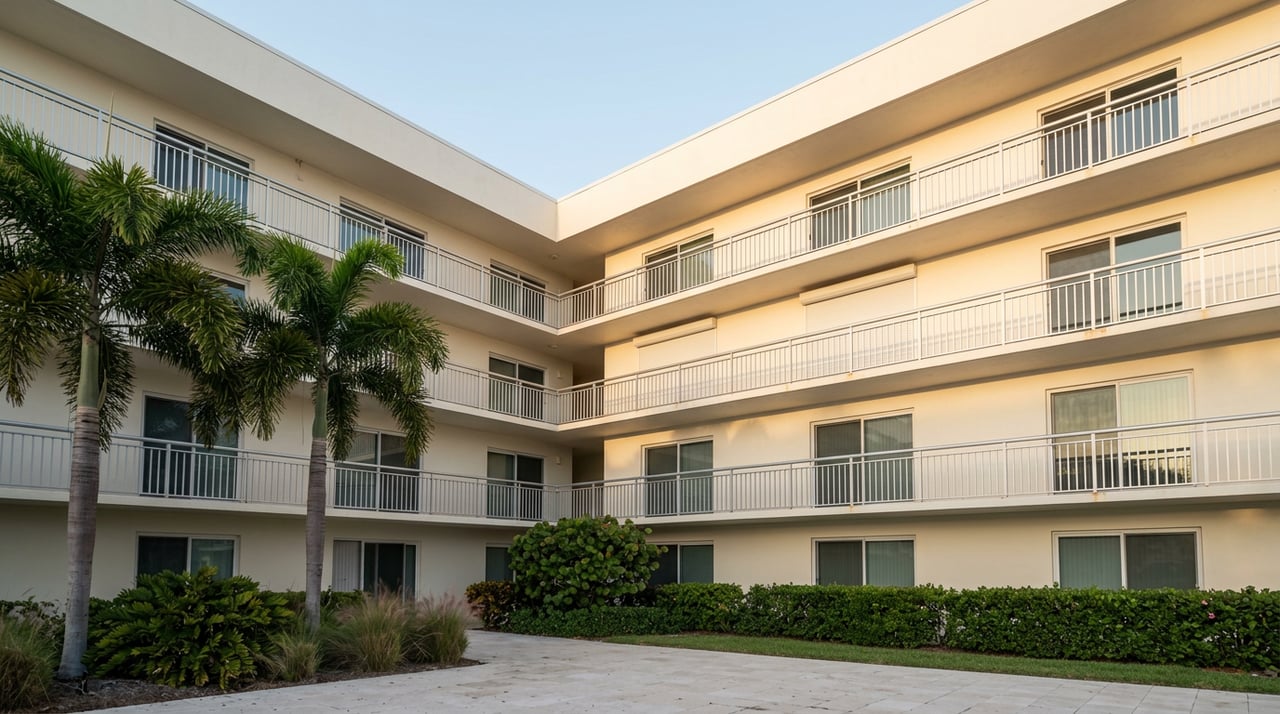
Barefoot Beach Club is twelve mid-rise buildings and 348 units built between 1991 and 1994, sitting directly on the Gulf on Little Hickory Island. Every building in the complex is now between 32 and 35 years old. That figure used to be a footnote in a listing description. Under current law, it is the number that determines whether a building has already missed a legally required structural inspection.
Florida requires condo and co-op buildings three stories or taller to complete a milestone inspection once they reach 30 years of age, or 25 years if the building sits within three miles of the coast, a trigger left to the discretion of the local building department. Every building here reached the 30-year mark between 2021 and 2024, which under the state's phased rollout meant an inspection deadline of either December 31, 2024, or December 31, 2025, depending on the exact year each building crossed the threshold. By this point in 2026, every building at Barefoot Beach Club should already have been through at least one round of that process.
The companion requirement, a Structural Integrity Reserve Study, or SIRS, became fully mandatory the same week. A SIRS spells out how much an association must reserve for eight specific structural components: roof, load-bearing walls, fire protection systems, plumbing, electrical, waterproofing, windows and exterior doors, and any other item above the state's cost threshold. For years, associations could vote to waive or reduce that funding to keep dues looking attractive. Under Florida's current condo statute, that vote is no longer available for budgets adopted after December 31, 2024, and full funding became a legal requirement on January 1, 2026.
What that means the day financing gets denied
This is where the low fee stops being charming. An association that waived reserves for years is now required to catch up all at once, and the way most boards catch up is a special assessment. One Barefoot Beach Club listing already shows this in practice: a unit where the seller covered the cost of a new resort-style pool assessment before closing, so the buyer would not inherit the bill. That is not a hypothetical scenario. It is a real transaction term, and it is becoming a normal one.
The quieter consequence shows up at the mortgage desk. Buildings that have not completed a milestone inspection or SIRS, or whose reserve fund falls short of the required schedule, can land on Fannie Mae's list of restricted, non-warrantable condo projects. More than 1,400 Florida condo buildings are currently on that list. A unit in a non-warrantable building typically cannot get a standard conventional mortgage. Buyers move to a portfolio loan or jumbo product instead, usually at a higher rate and under different qualifying rules, which changes the buyer pool and the negotiating leverage on both sides of the table.
That is the actual mechanism behind the fee reversal. A low number is not evidence of good management anymore. It is often evidence that the hard funding decisions were deferred, and the deferral window closed on January 1.
Before writing an offer here, the paperwork worth requesting looks different than it did a decade ago:
| Document to request | What it tells you |
|---|---|
| Milestone inspection report (Phase 1, and Phase 2 if triggered) | Whether the building's structural condition has been formally assessed, and whether Phase 1 turned up substantial deterioration serious enough to require Phase 2 |
| Structural Integrity Reserve Study | The dollar amount the association is legally required to reserve annually for each of the eight structural components |
| Last 12 months of board meeting minutes | Whether a special assessment is already under discussion before it becomes public |
| Current reserve funding schedule | Whether the association is funding at 100 percent or still working through a temporary catch-up period |
| Fannie Mae warrantability status | Whether the specific building currently qualifies for conventional financing |
A governance and disclosure explainer worth reading in full lays out these six due-diligence questions in more depth, along with what happens if a building fails to comply. The consequences are not limited to money. A building that misses its inspection deadline can be referred for an unsafe-structure determination, which carries the possibility of a vacate order forcing residents out, along with daily fines and personal liability exposure for board members.
The math behind slow days on market
None of this is theoretical for pricing. As of March 2026, the median list price for a Barefoot Beach condo sat near $2.99 million, with condos spending an average of 203 days on market before selling. Single-family homes in the same footprint moved even slower, with a median list price around $3.15 million and roughly 212 days on market as of July 2026. Active listings priced per square foot at Barefoot Beach were running near $1,060 as of mid-2026.
Those are not fast numbers for a stretch of coastline this well known. Limited inventory explains part of it. But the length of time buyers now sit with a decision that used to move quickly lines up with the same calendar as the reserve mandate. HB 1021 now requires associations with 25 or more units to post governing documents, budgets, and reserve studies online, and gives owners a legal right to view SIRS and milestone reports within 30 days of completion. Buyers who once made an offer on a view now have a document trail to read first, and reading it takes time.
For sellers, the paperwork is now the pitch
Florida law already requires the seller of a resale condo unit to hand the buyer the association's most recent financial statement and budget, along with the SIRS itself, or a written statement that none has been completed, and a milestone-inspection summary if one applies. What has changed is timing. Because that information is now supposed to be posted online rather than produced on request, a buyer can pull it before ever calling an agent.
The practical move for a seller at Barefoot Beach Club is to have that packet organized before the property goes live: the milestone report, the SIRS, the current funding schedule, and a clear answer on anything discussed but not yet voted. A listing that arrives with clean paperwork reads as a lower-risk purchase from the first showing. One that makes a buyer chase documents reads as a building with something to explain, whether or not that is true.
Quick answers
Does this law apply to the single-family homes in Barefoot Beach? No. Milestone inspections and SIRS requirements apply only to condominium and cooperative buildings under Florida Statute Chapter 718. The single-family sections of the neighborhood, including its beach and bayfront home enclaves, fall under Chapter 720 and are not subject to these particular structural mandates, though any homeowners association still carries its own reserve planning.
What if a seller says a special assessment already happened? Ask for the assessment notice, the vote record, and a plain answer on what it covers. An assessment tied to a documented SIRS funding schedule is a different risk profile than one passed in response to a Phase 2 milestone finding, since a Phase 2 finding of substantial deterioration triggers a state-mandated 365-day clock to begin repairs.
Can a restricted building still be financed? Yes, but not with a standard conventional loan. Expect a portfolio loan or jumbo product, typically at a higher rate and with different qualifying criteria than a warrantable building would require.
If you are weighing a unit at Barefoot Beach Club against one of the neighborhood's single-family sections that sidestep this law entirely, that distinction is worth walking through before an offer goes in. Bryan Tipple works this stretch of coastline daily and can help you read a SIRS report, a set of board minutes, or a listing sheet for what it actually says about the building behind it. Let's Connect.