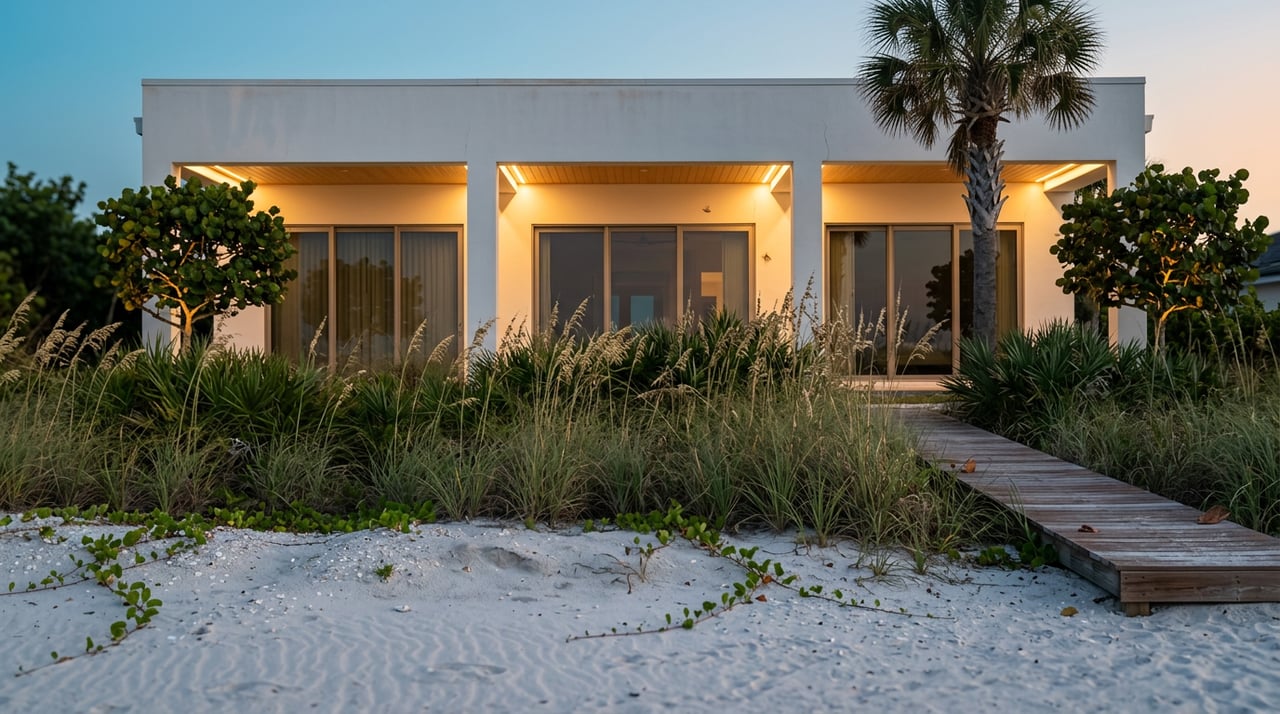
By early July, the stretch of sand between the gated entry at Barefoot Beach Boulevard and Wiggins Pass is doing quiet, serious work. Loggerhead nests sit staked in the dune line, hatchlings are beginning to move, and the county's monitoring team has been walking this beach at first light since April 15. If you live here, the season is not an abstraction. It is happening in the dune five steps from your beach access.
This guide is written for the resident, not the visitor. It assumes you already know where to park, where to shell, and where the sunset looks best. What it adds is the local context for what is happening on the sand between now and October 31, and the small changes to your evening routine that make the difference between a hatched nest and a false crawl.
What's already on the sand this summer
Collier County's Sea Turtle Protection Team recorded the season's first county-monitored nest right here. The Collier County Sea Turtle Protection Team recorded the first sea turtle nest of 2026 on Barefoot Beach, and the loggerhead nest has been staked by the team and will be monitored until the eggs hatch. The Conservancy of Southwest Florida logged its own first-of-season nest a day earlier on Keewaydin, so the two teams effectively opened 2026 in tandem.
That first stake is not ceremonial. The Transportation Engineering Department's Sea Turtle monitoring group started permit-required daily nest surveys on April 15, patrolling and recording sea turtle emergences, including nests and false crawls, along 22.5 miles of Collier County beachfront daily, with nesting season running from spring to the end of October each year. Barefoot is one of only five beaches the county monitors under this program, alongside Vanderbilt, Park Shore, City of Naples, and Marco Island.
Why this year's compliance matters more than last
The reason a resident's porch light matters comes down to a number most neighbors have not seen. On county-monitored beaches, 1,179 nests were recorded in 2025, compared to 996 in 2024. The highest recorded number for sea turtle nests for Collier County was 1,273 in 2023. So 2025 was a near-record season, arriving without a major storm to knock it down.
The takeaway for a homeowner is not that last year was great. It is that when a season goes well, the nest count on Barefoot climbs into densities where a single bright rear window facing the Gulf can disorient a full clutch of hatchlings at once. And 2025's success was earned partly by weather luck, which means this year's outcome leans harder on the human variables. As Mary Toro and Jeffrey Schmid, senior biologist for the Conservancy, both credited ongoing long-term conservation efforts, with Toro attributing the rebound to continued conservation efforts throughout the state for many years.
Translation for the homeowner facing west: your fixtures are part of the conservation infrastructure.
The evening rules, in plain language
The county's guidance is short, and it hasn't changed for this season. Environmental Supervisor Mary Toro asks residents to "turn off or shade lights from illuminating the beach by 9 p.m. and remove all beach furniture from the beach by 9:30 p.m."
For a Barefoot Beach resident, that translates into a handful of practical checks:
- Lights out or shielded by 9:00 p.m. on any fixture that throws light seaward. Pool cage uplights, second-floor lanai sconces, and landscape spots at the dune edge are the usual offenders.
- Furniture off the sand by 9:30 p.m. Loungers, umbrellas, coolers, and beach carts left overnight become obstacles for a nesting female and, later, for hatchlings scrambling to the waterline.
- No flashlights on the beach after dark. Don't use flashlights on the beach at night; lights deter turtles attempting to nest.
- Fill in the holes the kids dug. Fill in any dug holes for public and environmental safety. A knee-deep sandcastle moat is a hatchling trap by moonlight.
- Do not touch a returning female or a hatchling. Never stop a turtle that is returning to the water, and do not interfere with hatchlings heading for the water; this can weaken them and increase mortality.
If you see a stranded turtle, an injured animal, a disturbed nest, or a person interfering with either, the number to call is the FWC Wildlife Alert line at 1-888-404-3922. Contact the FWC (1-888-404-3922) if you witness any situation that may interfere with sea turtle activities.
The public-education layer that isn't there this year
Here is the piece most residents have not registered yet. In past seasons, part of Barefoot's turtle-season fabric came from Friends of Barefoot Beach Preserve, whose docents and lecturers translated the science for both neighbors and day-trippers. For 2026, that layer is thinner. Naturalist walks and talks will not be offered in the 2026 season. The lecture series is cancelled for 2026 season.
What remains open is the Learning Center itself at parking lot #1, with its displays on animal and marine life and printed materials on tortoises, shells, and birds. January through April, trained docents are on hand to answer questions and provide information, which means through the summer nesting stretch the space is self-serve.
That gap has a practical implication for residents. Visitors who used to get their orientation from a docent are now arriving without one. If a family on the sand is about to plant a beach umbrella through a marked nest, the person most likely to speak up this summer is a neighbor. Worth knowing before you find yourself in that conversation.
Walking the preserve during nesting season
The 342-acre preserve absorbs most of the foot traffic on the island, and the routes through it stay open and worth using through the summer. The Saylor Nature Trail is a 1-1/2-mile looped hiking trail through Barefoot Beach Preserve, accessible at the south end of parking lot #3 or off the northern path to the beach in parking lot #3, where a hiker can experience many of the native plants and animals of the Preserve. It runs behind the dune line, not through it, which is exactly what you want during nesting season.
A few things to keep an eye out for on a summer walk:
- Staked nests along the dune toe. The county team marks each one; give them wide berth on approach and departure.
- Gopher tortoises in the parking lots. State-designated as threatened, these terrestrial turtles have lived at Barefoot for decades, and the 342-acre barrier island has been a designated preserve since 1990, protected from the rapid development impacting the burrowing tortoise habitats across the region. A quick look under the car before you back out is a Barefoot habit for a reason.
- The estuary side. The Gulf here runs clear and shallow for 8,200 feet south to Wiggins Pass; the estuary on the island's inland side, threaded with tidal creeks and protected from motorboats, functions as a nursery for marine life. Paddleboards from the inland side let you avoid the nesting zones on the Gulf side entirely.
What the season looks like as it winds down
By late August the beach shifts from primarily nesting to primarily hatching. Emergences happen at night, usually on the tide that follows sunset, and a stretch of correctly darkened Gulf-facing homes is what lets hatchlings orient toward the brightest natural horizon rather than toward a lit lanai. The 2025 season closed on October 31, and the same official close applies this year. The 2025 sea turtle season was more successful compared to 2024, with no tropical storm damage during the nesting season, which set an expectation-line the 2026 numbers will be measured against once Toro's team publishes the annual summary in February.
There is a broader through-line here that residents feel more than visitors do. Barefoot mitigates the damage to the mainland when hurricanes come; barrier islands like Barefoot take the brunt of storm surge and winds, thin spits of land that anchor the coastline with thick tangles of vegetation. The same dune system that protects your street in September is the dune system a female loggerhead is choosing in June. Keeping one healthy keeps the other working.
The short version
If you take one page from this to your refrigerator, it is this. Lights off or shielded by nine. Furniture off the sand by nine-thirty. Fill the holes. Give the stakes room. Call FWC at 1-888-404-3922 if something looks wrong. The rest of the summer, enjoy the beach you already know better than any guidebook can describe it.
If you are thinking about your Barefoot Beach property in a longer horizon than this season, whether that means preparing to sell, adjusting outdoor lighting during a renovation, or exploring what else is available along this stretch of coast, Bryan Tipple knows the Barefoot Beach market at the property level and is happy to talk it through. Let's connect.